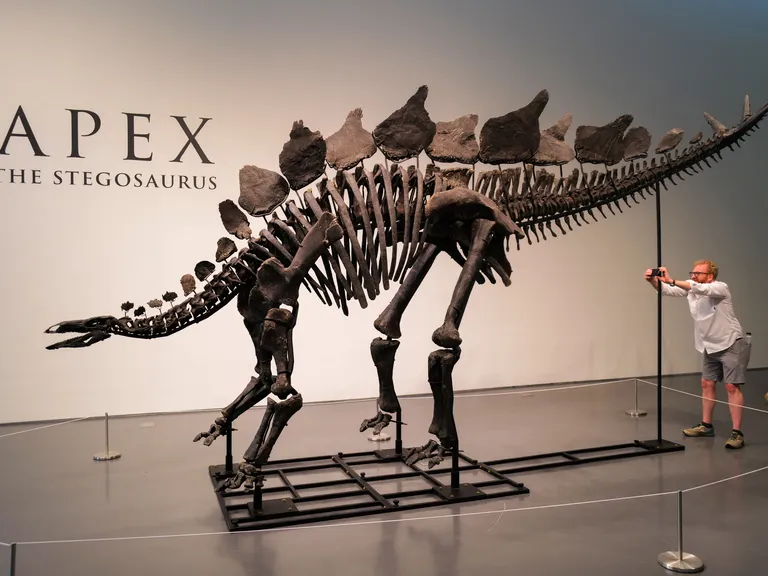
On Wednesday July 17th 2024, a Stegosaurus specimen dubbed “Apex” sold for $44.6 million at Sotheby’s, surpassing its auction estimate of $4-$6 million, and setting a new all-time record for the amount paid for any fossil. In 1997, the sale of the Tyrannosaurus rex fossil “Sue” (The Field Museum, Chicago) served as a watershed moment for these higher valuations and sales of iconic dinosaur skeletons, which reached a then- record high of $8.4 million. In 2020, the T. rex fossil “Stan” (Natural History Museum Exhibition, Abu Dhabi) exceeded $31 million at auction. The Association of Applied Paleontological Science wishes to extend congratulations to AAPS member Jason Cooper on his hard work in excavating and preparing this Stegosaurus specimen, which resulted in this record breaking sale event. Importantly, the exquisite preservation of this specimen is already providing important scientific information into dinosaur paleobiology, such as evidence of arthritis.
Apex’s purchaser is reportedly the billionaire hedge fund owner and founder of Citadel, Ken Griffin. Mr. Griffin is a generous benefactor to major museum institutions. In 2018, he gave $16.5 million to the Field Museum to fund the display of Màximo the titanosaur, a replica skeleton modeled from fossil bones excavated in Argentina that are among the largest of any dinosaur to be found. A perceived risk by paleontological stakeholders (academic and commercial paleontologists, auctioneers etc.) is that the rising market valuations of rare and largely intact dinosaur fossils will result in their being lost to science and to the world due to private buyers and collectors. The actual evidence for such landmark sale events is actually on the contrary, suggesting these concerns have less bearing in reality than the media may suggest. While relying on the benevolence of wealthy individuals to safeguard paleontological resources that come up for sale at auction is perhaps not ideal for most academic paleontologists, private ownership need not be a wall against scientific study nor must it preclude long term exhibition in major institutions and museums. Auction houses, sellers, and buyers of such rare and seldom found fossil specimens would do well to continue fostering collaborative relationships with major museums and professional researchers for the benefit of advancing paleontological science and educating the public about our shared geological heritage. Overall, the discovery and sale of Apex is a positive outcome attributed to the skills and labor of the commercial paleontology community, which is continuing to play an increasingly critical role in the discovery of fossil specimens that shed light on ancient life from our planet’s deep time past.
For any questions regarding the recent record breaking sale of Apex the Stegosaurus contact the AAPS.